



Our first-generation biobased technology
When we started working on bio-based & biodegradable coatings a few years ago, we decided to investigate raw materials that possessed those properties inherently. In a coating’s formula, the main ingredient concerned with those topics is the binder. The binder is a key ingredient because it is responsible for the stickiness on greenhouse, grass, and roof surfaces and it defines the product's durability (resistance to external factors like UV, condensation, rain, etc.).
Binders are polymer molecules and can be synthetic (derived from petroleum) or from natural origin (derived from renewable sources). Thus, to replace our current binders we looked at all promising biopolymers such as cellulose, starch, chitosan, PLA, PHA, PVOH, etc. One candidate stood out from the list and that was the starch, for the following reasons;
1. Availability
Starch is a common food ingredient that can be found in many cereals (corn, potato, rice, tapioca) and cultures all around the world. As Lumiforte, we aim to produce our coatings closest to the market to reduce our carbon footprint. Starch is a suitable option to help us achieve this goal. We will have local production of cereals transformed into a useful binder in our coatings. Last, starch can also be sourced from waste or other industry co-products (like food or paper).
2. Cost
The availability of raw materials for producing starch is high, resulting in reasonable prices compared to other biobased alternatives. This aspect is crucial for us at Lumiforte, as we strive to offer sustainable solutions to our customers at competitive prices. We believe that such an approach will facilitate a swift transition within our industry toward more sustainable alternatives.
3. Natural impact
Starch is fully biobased and biodegradable by international standards. The biodegradability of starch exceeds 80% within 28 days when exposed to water at ambient temperature.. Moreover, while being degraded starch feeds nature. Using a biodegradable polymer avoids the risk of releasing microplastics into the environment.
The technical challenge:
However, using starch as a binder in a coating formulation is not obvious, especially when an important property is wear resistance. E.g. we want to guarantee the protection of crops inside greenhouses for 4-6 months. Thus, to improve the product's durability, and to meet customer’s requirements, we have modified the starch polymer. These modifications enhance the water resistance of starch without damaging its biodegradability.
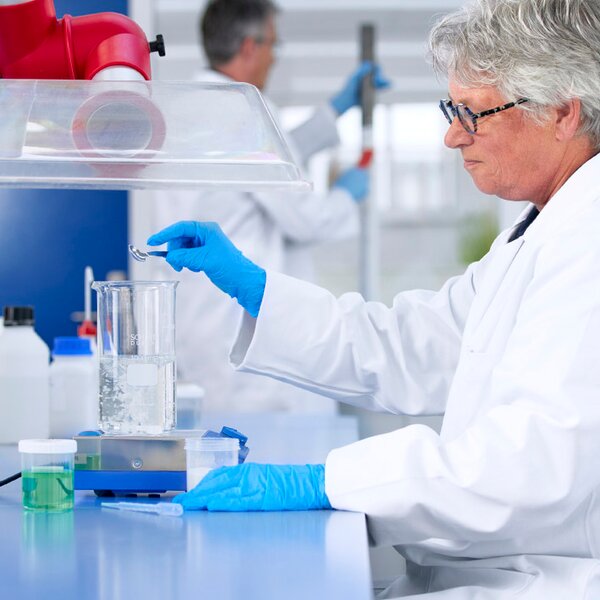
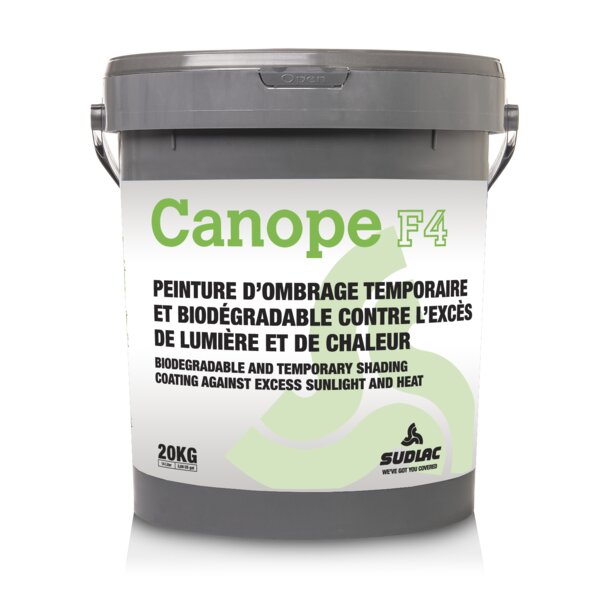
Under the Sudlac brand, Canope F4 is the first temporary coating developed with our patented starch-based binder.
With Canope F4, we demonstrate that a biobased binder can be used in a professional greenhouse coating without compromising durability. The product is designed to remain effective under UV, rain and condensation for approximately 4 months, while maintaining its biodegradability.
It is biodegradable according to OECD 301F standards (in water, at room temperature, over 28 days). The organic matter is composed of 89% bio-based material, while the mineral fraction consists of water and calcium carbonate.
This development is the result of in-house R&D and practical field validation. It marks the first commercial application of our biobased technology and lays the foundation for further developments in the coming years.